
November 3, 2026
Children usually don’t need much encouragement to talk. Ask them about a favorite game, a school adventure, or the injustice of having to go to bed at a reasonable hour, and you could be there awhile. Put them next to a grandparent with dementia, though, and they suddenly have no idea what to do. So how can you bring generations together during the holidays in a way that’s meaningful for all?
It’s not always easy. Dementia changes conversations in ways children aren’t used to. Grandpa doesn’t remember the story they told him yesterday. Grandma answers a question with something completely unrelated. A child who expected the grandparent they remember could become quiet, confused, or reluctant to try again.
You don’t need to orchestrate a touching holiday moment between them. You just need to remove some of the things getting in their way.
Instead of saying “Go visit with Grandpa,” give them a job to share.
Open-ended conversation asks a lot of both people. A child has to figure out what to say, while your parent has to follow the conversation and come up with a response.
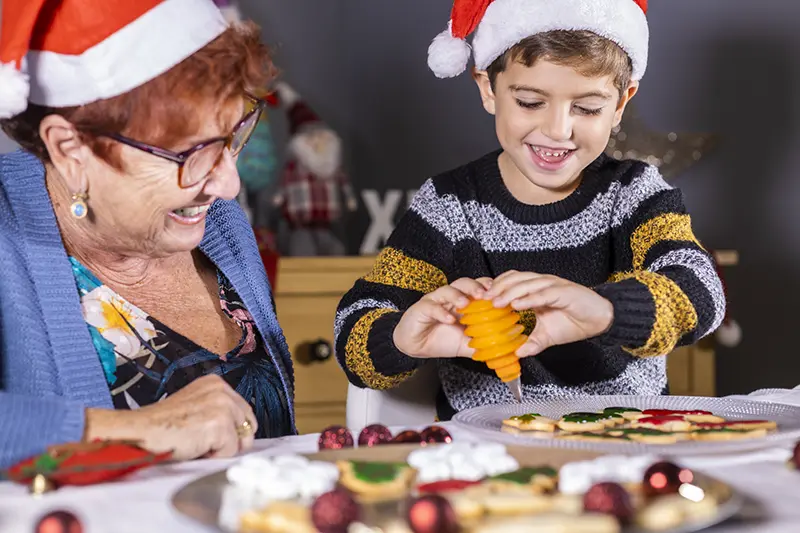
A shared activity gives them somewhere else to put their attention. Ask them to unwrap decorations together, put sprinkles on cookies, fold napkins for dinner, or choose which holiday cards should go on display. The activity itself doesn’t have to be important. In fact, something wonderfully unimportant is often just right.
Once they’re doing something together, conversation has room to come and go. A quiet minute doesn’t need rescuing, and nobody has to keep thinking of another question.
Instead of testing memory, talk about what’s happening right now.
Adults do this too, but children are especially fond of asking grandparents to remember things. “Do you remember my birthday party?” “Remember when we went to the beach?” “Do you remember what I got for Christmas last year?” When the answer is no, both people are reminded of what dementia has taken away.
Teach children a different way to start. They can show Grandpa their new shoes instead of asking whether he remembers them. They can point out something funny in a photograph rather than asking him to identify everyone in it. They can say, “I love this song,” instead of “Remember when we listened to this?”
Past memories are still welcome when your parent brings them up. They just don’t need to become the price of admission to the conversation.
Instead of expecting children to understand dementia on their own, explain what they’ll notice.
A child who doesn’t understand dementia could take a forgotten name personally. They could assume Grandma isn’t listening when she repeats a question or become embarrassed if she says something unusual.
Talk about those possibilities before the gathering. You don’t need a complicated explanation of brain disease. Tell younger children that Grandma’s memory isn’t working the way it used to, so she sometimes forgets names or repeats things. Older children are ready for more detail, especially if they’ve already noticed changes.
Also tell them what hasn’t changed. They can still say hello, share a joke, give Grandpa a hug if he likes hugs, show him something they made, or simply sit beside him for a while.
Instead of planning for an hour, aim for a good ten minutes.
Adults sometimes have ambitious ideas about intergenerational bonding. The grandchildren are here! Grandpa is here! Surely everyone should spend the afternoon creating memories together!
That’s a lot of pressure for two people who might both rather wander off after ten minutes.
Short visits work. A grandchild could help Grandma hang two ornaments and then go play. They could listen to three songs together, decorate a few cookies, or take a quick walk to look at the neighbors’ lights. If everyone is still having a good time, keep going. If attention starts wandering, call it a success and move on.
Instead of searching for the perfect activity, start with what they already like.
Dementia doesn’t erase your parent’s personality. If Grandpa has always loved music, start there. If Grandma enjoys being around the kitchen, let a grandchild help her with a familiar task. A parent who loves animals might be perfectly content sitting beside a grandchild and the family dog.
Look at the child, too. A shy eight-year-old and an energetic four-year-old aren’t going to connect with Grandma in the same way. Give each child permission to bring some of themselves to the relationship.
Holiday gatherings don’t need a carefully staged grandparent-grandchild activity to count as time together. Sometimes the best moments are much smaller: frosting one cookie, laughing at one photograph, listening to one song, or sitting beside each other without needing to say very much at all.
A Little Holiday Help Goes a Long Way
Dementia doesn’t take a holiday, even when the rest of the family is trying to enjoy one. We can help your parent get ready for gatherings, accompany them on outings, prepare meals, provide personal care, or offer company at home when a quieter day sounds better than another celebration.
Call Continuum at (314) 863-9912 to talk about what would make the season easier for you and your parent in Manchester, Kirkwood, Creve Coeur, or across St. Charles and St. Louis counties. A little help with the caregiving side of the holidays leaves you with more time to simply be together.